A lot of years ago, I was posted to Bahrain in the Middle East by my employer. I reported to a manager who was ex-British Army and who had served in the protection detail for the Omani premier, Sultan Qaboos.
The Iran/Iraq war had just started. Saddam Hussein, a Sunni Moslem, invaded his neighbour in an attempt to dominate the Gulf region and prevent Shia Moslem Revolutionary fervour spreading beyond Iran. He also wanted to secure the Shatt al-Arab waterway, Iraq’s border with Iran and only access to the sea.
Towards the end of my posting, both sides began attacking each other’s ships and other oil tankers in the Persian Gulf to disrupt their economies. Of course, this caused instability in oil and gas prices globally.
This conflict had little effect upon our lives in Bahrain. The land bridge to Saudi Arabia had not yet been finished – it opened in 1986 – an event which prompted firming of anti-alcohol laws in Bahrain. Until then, only wealthy Saudis could take an aeroplane on Thursday evenings to spend Friday carousing. Sometimes I’d find myself bumped off my reconfirmed First-Class flight from the Kingdom back home to Bahrain because someone important had turned up. Now the humblest of Saudi citizens could drive to sample this reputed wonderland of western excess for themselves.
But I digress. Bahrain has a significant population of Shia Moslem citizens. The Al Khalifa rulers are Sunnis. Official doctrine maintained that the Sunni faith was the majority, although many muttered quietly that the reverse was the case. Every so often, it would be announced in the Gulf Daily News that a cache of weapons had been discovered in the southern desert by the Bahrain Defence Force, thus foiling a potential coup. On one occasion, a Rigid Inflatable Boat full of Iranian revolutionaries was said to have attacked Bahrain by zooming into Mina Sulman, the main port area. It too was destroyed by the brave men of the B.D.F., crowed the newspapers. At an Embassy cocktail party, a British official told me his advice had been sought by His Highness, the Emir of Bahrain, Shaikh Isa. A raiding party of Iranians had been captured, he said. How many should he execute to send the appropriate message? I was not told how the official answered this awkward question.
But it all seemed relatively benign to me. I put these skirmishes down to minor ethnic or cultural squabbles – nothing more. Perhaps some had even been manufactured by the government as a mild warning to others. But I was young and naïve, not yet much exposed to the wider wickedness promulgated by those who are powerful.
The manager I referred to above was wise enough to tell us that westerners could never properly understand the layered politics of that region. We might try to mimic Persian or Arab thought patterns, but so often, my own efforts to do this were confounded by an inexplicable reaction, so I gave up trying. The man did impress upon me the need for westerners not to interfere with such complexity which we don’t understand. The danger is that many of us think we do. We say, “I know: remove the leader – then everyone will fall into line behind a new leader who will emerge from the ranks of Those Most Likely.” The source of this simplistic logic is easy to find. I mean, that’s what happens in a western democracy – we vote out our president or prime minister and his (it’s almost always a man) deputy steps in. We used to say, ‘The King is dead – Long Live the King’!
Iran may have had a Supreme Leader, but there are eighty eight clerics in the Assembly of Experts, the prime constitutional body. They will choose his successor. Another six clerics in the Guardian Council review candidates and check legislation for adherence to religious doctrine. There’s also an Interim Leadership Council which takes over during the interregnum when the Supreme Leader dies. There are plenty for the regime to choose from.
When the former Shah of Iran was deposed in 1979, the Iranian Revolutionaries formed a complex and robust administration with the idea that it should withstand attack from outside. The Revolutionary Guard, (I.R.G.C.) numbering some 130,000 active members is supported by a further 90,000 paramilitary voluntary militia, the Basij. Together with local Police, they act to enforce Islamic doctrine upon all activity in the country. We have seen over recent years that any hint of objection or dissent by the people is quashed in a brutal manner by these authorities. Tens of thousands of protesters have been machine-gunned and the injured hunted down and imprisoned.
Westerners find this abhorrent, of course. But some of us remark, sagely, that these tribal societies function best when a Strongman is in charge. Examples might include Hosni Mubarak of Egypt; Muammar Ghaddafi of Libya, Saddam Hussein of Iraq, Hafez and his son, Bashar Al Assad of Syria and Zine Ben Ali of Tunisia. All were authoritarian. Their time in office was one of repression and corruption, and their peoples would complain if they dared, but usually admitted that the alternatives might be far worse. At least their country was stable and they knew where they stood. I would point out that Abu Musab al-Zarqawi was not able to start ISIS until the early part of this century, when influence of the strongmen in Iraq and Syria was waning.
None of these men stepped down and handed the reins of power to a successor, retiring to live out their days in peace. Sometimes they were removed (often with western help) and opportunist tribal leaders immediately grabbed whatever they could. Libya, for instance, remains dived between rival administrations, since Ghaddafi was killed in 2011.
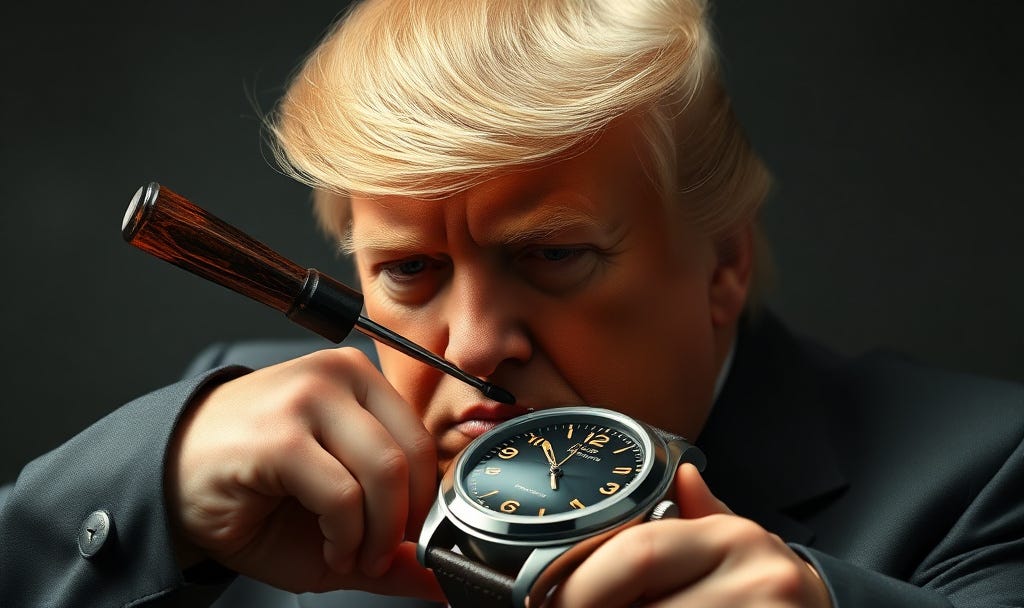
That manager in Bahrain, who so influenced my thinking, likened the Middle East to a wrist watch. He would say, ‘If you look at its face, there is little movement to see. Everything is calm, ordered …slow and predictable. Now turn it over and remove the back of the watch. Springs, levers, cog wheels and all sorts burst out. The workings go everywhere and you realise you’ll never put the pieces back as they were.’
Now we watch the baseball hat-wearing 47th President of the United States squatting in his Florida basement ‘situation room’, proselytising about the righteousness of his Iranian War. He tells the Iranian people to rise up and seize their once-in-a-generation chance for self-determination. They can’t hear, though, as Starlink isn’t operative right now and such communication and liaison between insurgent groups is tricky unless supported by ‘Boots on the Ground’. MAGA would hate that… And then there’s Pete Hexface, his pumped-up Brylcreamed News Anchor pretending to be a Secretary of WAR (Sorry about the use of capital letters). He behaves at Press Conferences as though he wants to bite off the ends of the microphones to show he’s reet ‘ard, like. The politest description I can come up with is to call it ‘performative’.
There were reasons that Saudi Arabia, Qatar, the Emirates and others did not mount all-out assaults on Iran decades ago. The delicate balance between Israel, Iran and the Gulf Cooperation Council countries has been like that imaginary watch. Now Netanyahu of Israel wants to stay out of jail and be re-elected for his own domestic reasons. One might say much the same about Number 47, although his chances of re-election may yet be thwarted. But these two are using each other. Their people are paying for it in treasure and the wider populace of the region is paying in blood as well.
Here in Europe, we moan about refugees fleeing persecution, crossing borders and floating up to our shores for safety and a new life. Some may be economic migrants; some may fear for their lives as well as their livelihoods. It’s worth pointing out that if significant sections of the Iranian populace of 93 million flee to the west, we’ll ‘have a problem, Houston’.
Is Number 47 going to poke the hornets’ nest and then run away, claiming victory? After all, he gave the Iranian people their only chance. It ain’t his fault if they didn’t take it…
I miss that manager. R.I.P. Mike.